12 Orthoceras Quarry. Geological History
Orthoceras Quarry
This legendary site is known for its dense accumulations of straight‑shelled Silurian cephalopods — orthocerids, which gave the quarry its name. Orthocerids are extinct relatives of today’s cephalopods such as cuttlefish, squid and octopuses. Unlike their prehistoric ancestors, only one modern species still has an external shell: the nautilus.
Orthoceras Limestone Photo: Štěpán Rak
The nearby village of Lochkov features three coiled cephalopod shells in the upper part of its coat of arms, recalling the rich fossil heritage of the area — although coiled forms are rare here. Straight orthocerids, however, are extraordinarily abundant. The limestone layers in the upper quarry and on the scree slopes contain thousands of cone‑shaped shells washed together over time. Curved and, very rarely, coiled forms also appear, along with numerous bivalves. Trilobites, by contrast, are relatively scarce.
In the now‑abandoned Marble Quarry below Lochkov, orthoceras limestone was once quarried, cut and polished for building façades. On Zbraslav, 46 pavement curbs in Hauptova Street are made from this stone — often incorrectly called marble. It is easy to recognise: the black limestone matrix sharply contrasts with the white fossil shells, especially the long, straight orthocerids.
A polished slab of this stone is also displayed near the footbridge by the Radotín church, at the Geozídka site. The stone has not been quarried for more than 80 years, making every preserved piece a rare reminder of this unique rock.
Geological History
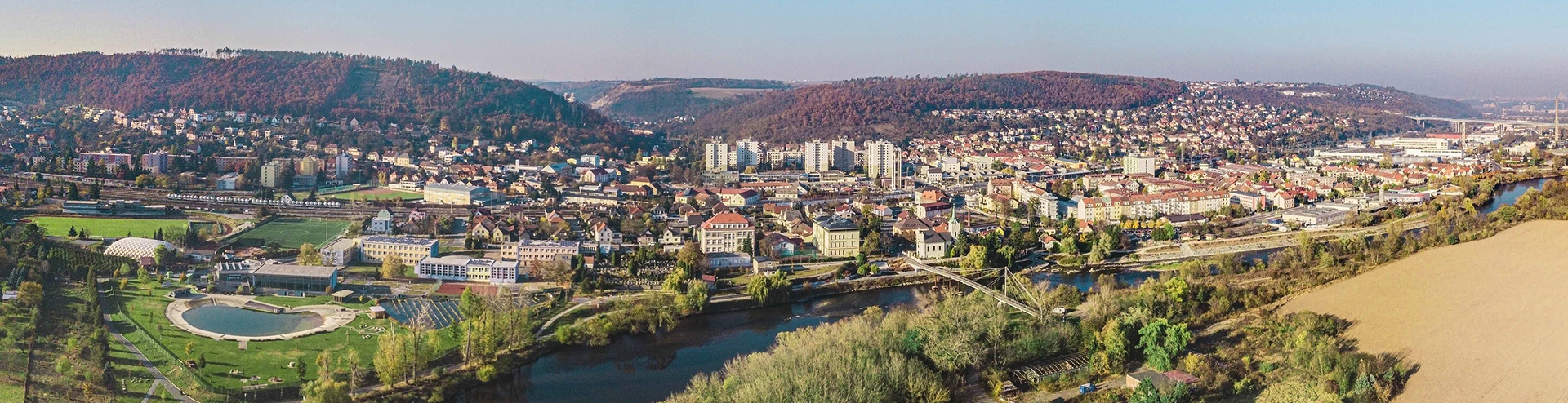
Radotín lies in a broad valley composed mainly of marine sediments — especially limestones and clay shales — with occasional volcanic rocks. Today, we are walking on the floor of an ancient sea. Over millions of years, sediments accumulated to such depths that they now form the tall limestone cliffs where fossils preserve the story of long‑vanished life.
The oldest rocks in Radotín are Ordovician shales, found for example near Staňkovka, on the road to Třebotov, and above the railway toward Velká Chuchle. Silurian rocks are widespread around Lochkov and Klapice. The most prominent rock formations — the Radotín cliffs, the quarry walls near the cement plant, and the rocky gorge of the Šachetský Stream toward Kosoř — are built of Devonian black and grey limestones.
Bivalves of the genus Cardiolinka found here Photo: Štěpán Rak