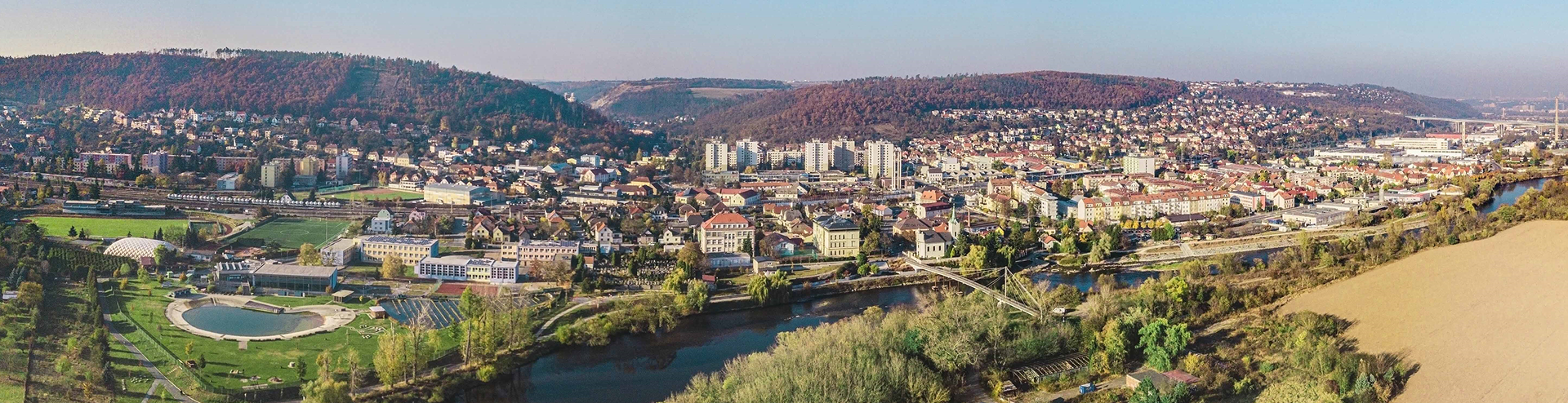
13. The Cement Plant and Other Industrial Enterprises
Until the mid‑19th century, Radotín was a small farming village. The only pre‑industrial operations were watermills on the local stream. Small‑scale lime burning, brickmaking and stone quarrying also took place here, including the extraction of the well‑known black and pink “marble”. Basket‑making was another traditional craft.
View of Radotín from the direction of Prague, around 1909 Photo: Archive of the Radotín Chronicle Committee
The arrival of the railway in 1862 triggered an industrial revolution in Radotín. The first and largest enterprises were the cement plant and the sugar factory. A major lime kiln operated here as well, and additional factories appeared rapidly, especially at the beginning of the 20th century. As industry expanded, the village grew just as quickly: around 1850 Radotín had 36 houses and 301 inhabitants, but by the end of the century it already had 102 houses and 1,273 residents.
Factory complex near the railway station, used by Marsano & Prager (1899–1904) and later by Janka (from 1907) Photo: Archive of the Radotín Chronicle Committee
Industrialisation also transformed the landscape. The cement plant in the centre of the village significantly affected daily life, and the surrounding countryside changed due to numerous quarries. Radotín’s industry continued to grow and prosper throughout the 20th century. After World War II, the communist regime nationalised private companies and abolished small businesses. Some major factories, however, still operate today — including the cement plant and Janka.
Josef Vindyš built his factory in Radotín in 1907 Photo: Archive of the Radotín Chronicle Committee
Industrial centre of the town in 1912, photographed from the school near the church Photo: Archive of the Radotín Chronicle Committee
Cement production in Radotín has a tradition of more than 140 years, dating back to 1871. The current cement plant was built in 1961 as a replacement for the original factory in the town centre, which ceased operation in 1963.
The “Přední Mašek” mill once stood on the site of today’s cement plant Photo: Archive of the Radotín Chronicle Committee
Production begins with quarrying in Hvížďalka and Branžovy (both with an expected lifespan until 2045; operations in the Špička quarry are being phased out). The large clinker silo on the left can hold up to 40,000 tonnes of material. The plant produces approximately 0.7 million tonnes of cement per year, transported by rail and tanker trucks.
Prepared in cooperation with Českomoravský cement.