16. Historical Stop
Mills, the “Red Whitsun” Gathering, and the Cement Railway
The Cement Railway
The original cement railway connected the “old” cement plant with the limestone quarries. It was built in 1873. At first, the wagons were pulled by horses, later by a small steam locomotive. Quarry workers sometimes pushed empty wagons uphill themselves — often with help from family members — while the loaded wagons travelled downhill by gravity.
When operations ended in 1959, the railway measured about 2,000 metres, with an additional 500 metres branching toward the quarry behind today’s administrative building of the “new” cement plant, and another 700 metres leading toward Cikánka near today’s bus stop “Lomy”. The track gauge was 600 mm, a standard size for mining railways. The wagons had two axles and wooden sides, resembling small coal wagons. According to local accounts, the wagons were transferred to Chýnov near Tábor after the railway closed, while the locomotives were likely scrapped. After 1959, stone was transported to the cement plant by dump trucks.
Technically, the railway was a single‑track line with several branches. In Radotín, it included a small three‑track yard, located between Vinohrady and Slinková Street, roughly between Strážovská and Prvomájová. One track continued across Prvomájová Street to a stone‑crushing facility, situated near today’s house No. 1365 on Osvoboditelů Square.
Today, only memories, a few historic photographs, and the street name U Drážky (“By the Little Railway”) recall its existence.
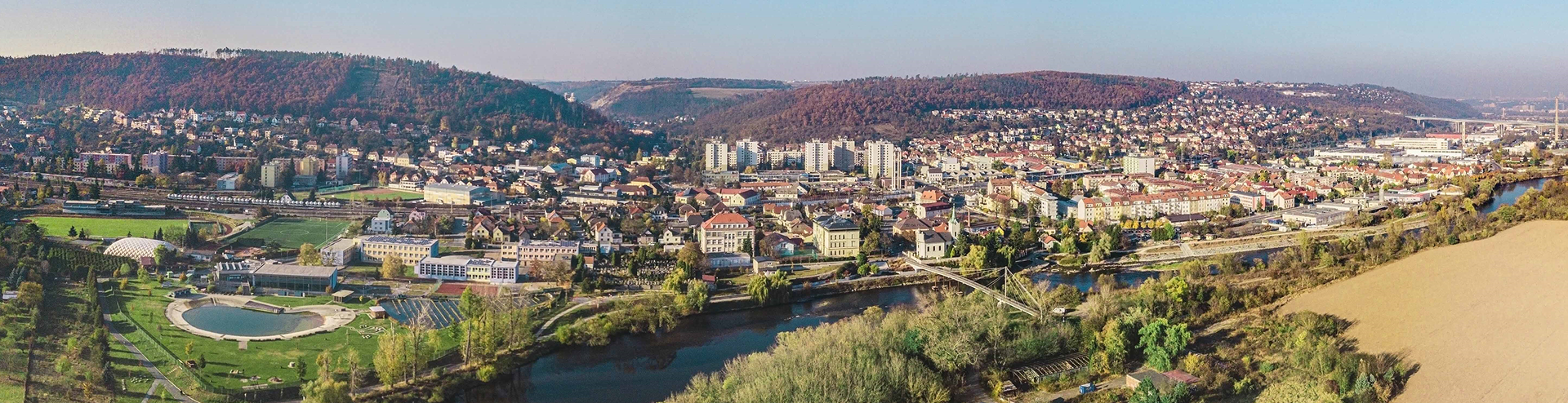
View into the Radotín Valley Photo: Archive of the Radotín Chronicle Committee
More about the former railway in the story by Karel Dušánek on the website of the Radotín Chronicle Committee: https://www.letopisciradotin.cz/l/po-stopach-zanikle-drazky
Mills
Behind the road lies the campus of the Klapice Vocational School. Few people know that most of its buildings were constructed on top of the filled‑in mill pond belonging to the Hořejší–Böhm Mill, No. 11. The pond was filled in 1958 using soil excavated during the construction of the new cement plant rail siding on the opposite side of the valley.
The first written mention of the mill dates back to 1432. The mill pond — or more precisely, ice‑skating on it — became extremely popular in 1935, when the rink came under the care of the Sokol organisation. Organisers provided excellent service, including cloakrooms, skate storage, refreshments and well‑maintained ice. Skating took place to music, and in the evenings even under artificial lighting.
Along the entire Radotínský Stream, which rises near Ptice about 22 km away, there were once 22 mills. Today, only the Veselý Mill in Choteč remains in operation. The others have been converted into recreational cottages, permanent homes or company premises. Some disappeared completely — such as Přední Mašek Mill, now the site of the cement plant. The Šarboch Mill and Kalina Roller Mill were demolished to make way for the cement quarries.
Mašek Mill Photo: Archive of the Radotín Chronicle Committee
Šarboch Mill in 1919 Photo: Archive of the Radotín Chronicle Committee
Mills in Radotín
Within the present‑day boundaries of Radotín, there were once four mills:
Brouch Mill (U Hadrů)
This mill is mentioned as early as 1499, when King Vladislaus II granted the abbot of the Zbraslav Monastery the right to produce paper from rags. The mill was completely destroyed during the Thirty Years’ War, and a new mill — later known as the Rag Mill — was built on the site in 1684. It operated until 1925.
After it closed, the building was divided into two parts. One was purchased by the company Bárta & Tichý, later Prastav, which established a workshop for crushing and processing marble. They produced “granito” and slabs of black marble quarried above the former Fotofon factory. The second part housed an ironing workshop and, for a short time, a soda‑water plant.
The mill included a garden and a dance hall, where social events and Sokol celebrations were held before World War II. After the war, the property was confiscated and taken over by the company Flieder, later Janka. The dance hall was converted into a canteen for the vocational training centre built in the mill’s former garden. Today, the site houses a garden‑supply shop.
Opposite the stream stands the original building of the Rag Mill, whose name reflects the historic right to produce paper from old textiles. Upstream followed the Hořejší–Böhm Mill.
View of the Böhm Mill Photo: Archive of the Radotín Chronicle Committee
Thi Mill Pond
The mill pond was especially popular in the 1930s, when people skated here to music, and in the evenings even under artificial lighting.
In the 1930s, the mill was converted into a sawmill, which was nationalised in 1948. A tractor and machinery station was later established here, and today the site is occupied by a trade school. The pond was filled in 1958 using soil excavated during the construction of the new cement‑plant rail siding on the opposite side of the valley.
Photo: Archive of the Radotín Chronicle Committee
Another mill within Radotín’s boundaries was the Middle Mill – also known as the Parson’s Mill or U Hamanů, No. 27, later converted into a residential house.
The last mill before the stream entered the Berounka was the Lower Mill – Šnajperk’s Mill. During the Thirty Years’ War, it stood abandoned and in ruins, like most buildings in Radotín. In 1869, Radotín’s first post office was established here, with innkeeper Alois Haman serving as the first postmaster.
The Lower Mill ceased operation before the end of the 19th century. It was purchased by Antonín Vichr, who founded the company Vichr & Sons, producing metal goods — the site became known as Vichrovna. After World War I, the property was bought by Mr. Broulím, who established an enamel factory. After nationalisation, it was taken over by the cooperative Smalt. Today, the site houses S&S Air Technology and the Horymír Brewery.
Water for the last two mills in the village centre was supplied by a millrace, which ran between Radotín’s farmsteads, passed through a small tunnel under the railway, continued to the Lower Mill, and re‑entered the stream near the ferry crossing.
The section of the Radotínský Stream from the millrace junction to its confluence with the Berounka was known as the “Barren Stream” (Jalový potok), because most of the water was diverted into the millrace, leaving only a small amount in the natural channel. Carts often travelled directly through the stream, and instead of bridges, people crossed on stepping stones or simple wooden footbridges known as “necky”.
More about the mills on the Radotínský Stream can be found on the website of the Radotín Chronicle Committee: • Lecture on the mills: https://www.letopisciradotin.cz/l/mlyny-na-radotinskem-potoce • Map of the mills: https://www.letopisciradotin.cz/mlyny
Red Whitsun
On this stone pedestal once stood a monument commemorating an event that took place here on 20 April 1930, Easter Sunday. The incident later became known as Red Whitsun (Rudé letnice).
It was a gathering of communist and workers’ youth led by Communist Party MP Václav Kopecký. Some participants, however, apparently did not realise it was a political demonstration. They met in Kosoř and marched toward Radotín, where the event had been officially banned. At the edge of Radotín, their path was blocked by a cordon of gendarmes. The crowd ignored calls to stop and began throwing stones. During the clash, the gendarmes injured five girls. Communist propaganda quickly seized on this tragic failure, turning the incident into a powerful political tool. Through a gradual layering of distortions and half‑truths, Red Whitsun was transformed into a myth, elevated to one of the great milestones of the workers’ movement — with the injured girls even falsely portrayed as having been shot dead.
In April 1950, a monument to Red Whitsun was unveiled here. It became a site of mandatory annual homage for the entire town — from schoolchildren to factory workers.
Guard of honour at the Red Whitsun monument, 1974; second photo from 1984 Photo: Archive of the Radotín Chronicle Committee
Red Whitsun was elevated to an event of nationwide importance, appearing in encyclopaedias and school textbooks. Based on a novel by Alena Bernášková, director Jiří Sequens made the 1954 film Olověný chléb (Lead Bread). Watching the film became a compulsory activity for Radotín schools.
In 1992, the monument was demolished.