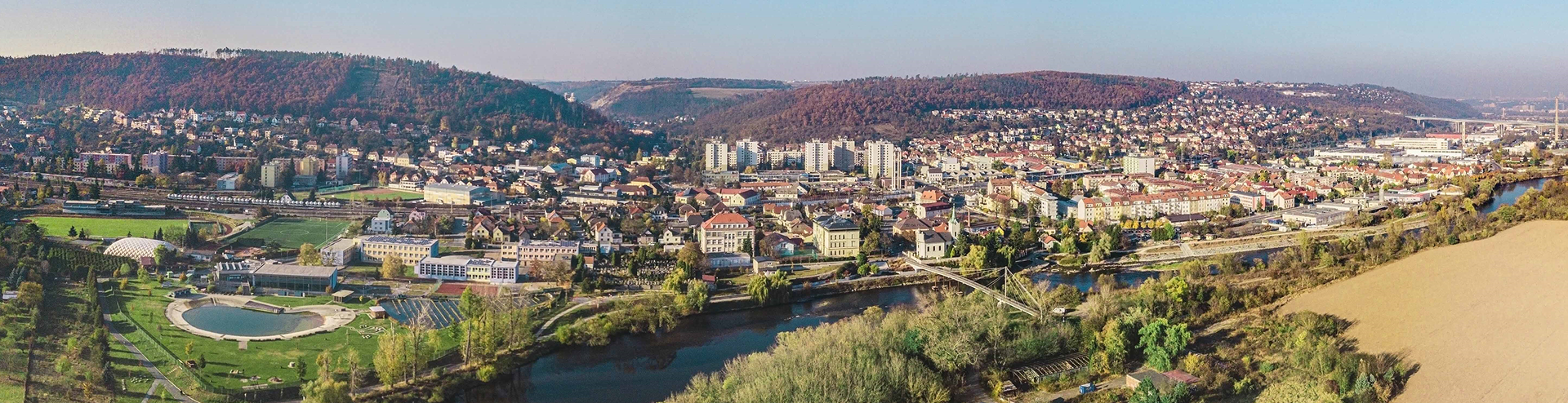
4. Sport and Local Clubs
In 1953, all sports activities in Radotín were united under the sport association TJ Spartak Radotín, which included football, basketball, tennis, table tennis, canoeing, volleyball and hockey. Four years later, a hiking section was founded, and in 1958 a wrestling section was added. In 1961, as part of the “Action Z” volunteer programme, construction began on a new stadium with seating for around 10,000 spectators and a covered grandstand. In 1966, a bodybuilding section was established within Spartak Radotín, using the Sokol hall. Despite modest conditions, several successful athletes grew up here.
A major change in the organisation of Radotín’s sports clubs came in the early 1990s. In 1991, the Sokol organisation successfully requested the return of its property. As a result, Spartak Radotín was dissolved on 1 September 1991. Sections using the indoor and outdoor spaces of the Sokol hall remained under Sokol (general sports, lacrosse, badminton, bodybuilding). Under TJ Radotín were included football, softball, foot‑tennis, bowling, athletics and volleyball. In 1992, TJ was renamed RSK. Tennis and basketball formed their own club, LTC, while other sports (canoeists, hikers) created independent organisations.
In 2004, the football, athletics and bowling sections separated from RSK and formed a new club called Sport centre Radotín (SC Radotín). Today’s Radotínský SK (since 2004) brings together softball, volleyball, foot‑tennis, basketball and pétanque. It operates at two sports sites: the beach‑volleyball, volleyball and foot‑tennis courts below the new stadium, and the softball field (formerly the football pitch) at the old sports ground
In 2009, a modern multi‑purpose sports hall was opened on the site of the old stadium. The hall meets all standards for top indoor sports. During the 2009–2010 season, it even hosted the highest Czech basketball league, Mattoni NBL (home court of Sokol Vyšehrad). The hall can be divided to allow three sports to be played at once and includes a climbing wall, sauna and accommodation.
The Sokol hall, the multi‑purpose sports hall, school gyms, floodlit outdoor fields (lacrosse, football, softball), beach and volleyball courts, tennis courts, bowling alley, boathouse and athletics track together create excellent conditions for sport in Radotín.
Sokol
The first gymnastics association in Radotín was named Sokol. /in Czech „ sokol“ means a falcon /Local residents embraced Tyrš’s ideals and the patriotic motto “Every Czech a Sokol”. On 28 October 1888, the founding assembly established Sokol Radotín. On 27 January 1889, Václav Drchota was elected its first chairman; he also served as the commander of the Volunteer Fire Brigade. Training first took place in the inn U České koruny, while the garden and the area behind the barn served as outdoor exercise grounds. In 1928, the first proper gym was set up in the former sugar factory (No. 49), which also included a summer training area. In 1932, a new representative Sokol Hall was built on the land between today’s Grafitová and Vykoukových streets, featuring a large hall, a restaurant and an outdoor sports field.

Sokol training behind the Drchota farm barn
Photo: Archive of the Radotín Chronicle Commission
From the very beginning, many sports were practised here – ball games, gymnastics, athletics and later football. As was common in the 1930s, public mass‑gymnastics performances were regularly held on the field, always preceded by a festive parade of members in uniform. The parade, accompanied by its own band, traditionally marched from the railway station through almost the entire town to the Sokol Hall. Radotín’s Sokol members also took part enthusiastically in national Sokol gatherings.
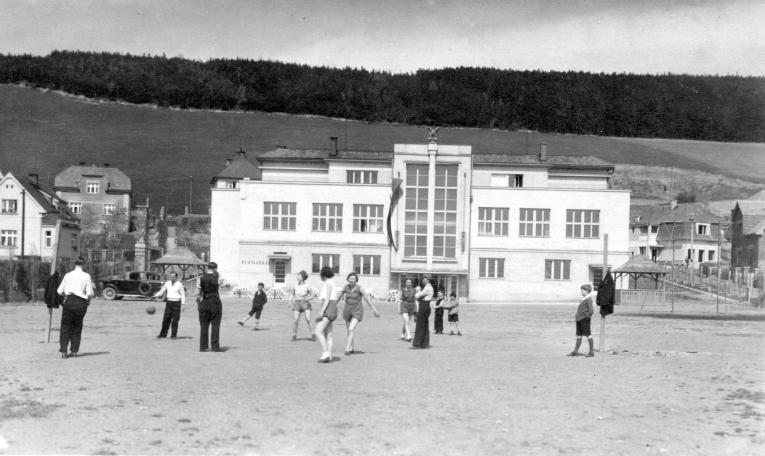
The new Sokol Hall built in 1932
Photo: Archive of the Radotín Chronicle Commission
Sokol’s activities were interrupted several times – in 1941 during the Protectorate and again after the political changes of 1948. After the war, the organisation was restored in May 1945. Between 1950 and 1954, political authorities imposed several new names on the sports organisation: Sokol Kovocement, Sokol Kovo, Spartak Aero, Spartak Stavoloko, until the name finally stabilised as DSO Spartak Radotín.
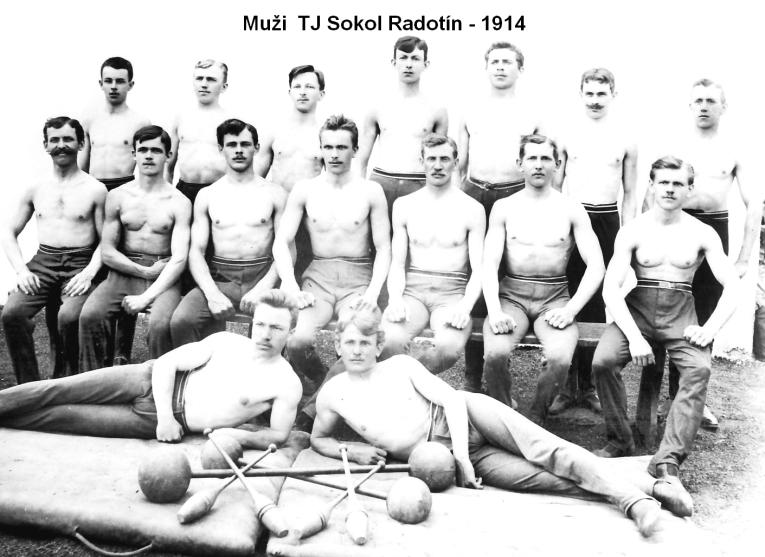
Sokol members in 1914
Photo: Archive of the Radotín Chronicle Commission
After 1989
After 1989, the tradition of Sokol was successfully revived. The preparation committee for re‑establishing TJ Sokol Radotín was led by Ing. Vladislav Šimáček, who also became the first chairman after more than forty years since 1948. In 2001, Miroslav Knotek was elected chairman.
Under Sokol today operate the sections of badminton, gymnastics, bodybuilding, lacrosse and general fitness.
Badminton
The badminton section was founded in 1973. After a modest beginning, the performance level in the youth categories soon rose sharply. In 1995, the club won its first national title in boys’ doubles in the younger pupils’ category. In 1997, it achieved its first national title in the mixed youth team competition.
Another major turning point came in 1998, when most players from the first‑league adult team of TJ Meteor Praha transferred to Radotín. This allowed the Radotín team to enter the highest national league. What followed was the most successful period in the club’s history: the A‑team won the 1st National League several times. Youth teams also repeatedly won national titles in both pupils’ and juniors’ competitions.
The opening of the new sports hall in 2009 made it possible to work intensively with young players directly in Radotín. The club established a badminton training programme for children, which continues to develop new talent.
Lacrosse
The original game of the Iroquois people found its way to Radotín in the early 1980s. Lacrosse Club Custodes Radotín (LCC) was founded in September 1980 so that members of the local Youth Hiking Club could take part in the league of one‑handed “Czech lacrosse”. What was meant to be only a team name soon became an independent sports club.
In 1990, LCC became part of Sokol Radotín, gaining the facilities it had previously lacked. Two years later, the club built its own field and began working with youth players. Another milestone came in the 2000/2001 season, when the playing surface was completely renovated and artificial turf was installed.
In the following years, stands, artificial lighting and reinforced glass boards were added. The year 2001 also marked a turning point for the Aleš Hřebeský Memorial: from its 8th edition, the former pre‑league tournament became an international event. For the first time, teams from abroad (USA, Germany and Japan) took part, making it the first box‑lacrosse tournament in the world with participants from more than two countries.
The Aleš Hřebeský Memorial
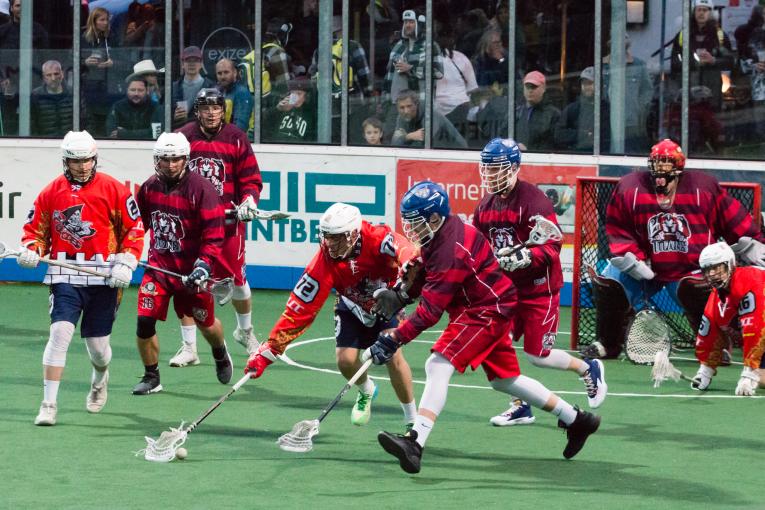
The biggest annual sporting event in Radotín – the international lacrosse tournament Aleš Hřebeský Memorial – returned in 2022 after the pandemic break. Among 20 teams from around the world, the home team LC Custodes (in red‑white‑blue colours) claimed victory.
Photo: Karel Mokrý
DTJ – Workers’ Gymnastics Association
An important sports organisation in Radotín was the Workers’ Gymnastics Association (DTJ), founded in 1902. Its members first trained in the inn U Brüknera (later U Horymíra, No. 72) and later in the inn U Bíšků (No. 161). In the 1920s, training took place in the school gym.
In 1925, DTJ established a strong local tradition of handball. At first, matches were played on the football field, and from 1930 on the banks of the Berounka, at the site of today’s car service station. From 1935, Radotín handball players used the Sokol training ground, and in 1940 the cinder field of RSK. During the war, Radotínský SK was the only sports organisation allowed to operate, so the entire handball section, including players and officials, moved under its structure.
In the same year, an ice‑hockey section was founded. The ice surface was prepared on the football field, and after the war hockey was also played on the Sokol training ground. However, the rink could operate only during strong frosts, as there was never an artificial ice surface. The activities of DTJ ended after 1945.
Today, the Radotín Sports Club (RSK) brings together the sections of basketball, pétanque, softball, volleyball, a climbing group and foot‑tennis.
Basketball
Basketball is one of Radotín’s long‑standing sports traditions. In 2008, it had been sixty years since the Sokol men’s team played its first official season in the local Sokol Hall. In 1948, the men’s team officially entered league competitions. Matches were played both in the Sokol Hall and, in good weather, on the outdoor field adapted for training. For many years, the team competed in the top division of the Central Bohemian Region and was rarely defeated at home.
After becoming part of TJ Spartak, the volleyball court on the tennis grounds was adapted for basketball, but despite its beautiful setting, it was not used very often.
During the 1970s and 1980s, several important changes took place, including a move to the primary school gym and, in 1975, a transfer to competitions organised by the Prague Basketball Association, which offered a much higher sporting level than the regional league. Perhaps the most successful era of Radotín basketball came in the 1990s.
After the Velvet Revolution, the club expanded again: alongside the men’s and youth teams led by PE teacher and current mayor Karel Hanzlík, women’s and girls’ teams were re‑established. The men’s roster included legendary Czech player Jiří Zídek Sr., the greatest figure in Czech basketball history, as well as several players with national‑league experience. Success soon followed: in the 1993–1994 season, the strongest team in Radotín’s history won the Prague Championship ahead of USK’s B‑team and earned the right to advance to the 2nd National League. After considering time commitments and the fact that basketball was mainly a hobby for the players, the club decided not to take the promotion.
Radotín basketball also experienced a unique moment in 2007, when Jiří Zídek Sr., then 63 and finishing his playing career, appeared in an official match alongside his son Jiří Zídek Jr., the first Czech player with experience from the NBA.
Softball
At the turn of 1978 and 1979, a new sport—softball—became part of Spartak Radotín. Today it is one of the oldest and most successful softball clubs in the Czech Republic. The men’s team has long competed in the top national league, regularly finishing in medal positions. The club includes many current and former national‑team players and coaches.
Between 2004 and 2009, the club experienced significant growth. A women’s A‑team was formed, successfully qualified for the second league, and in 2007 won the competition and advanced to the top division—the 1st Czech Women’s Softball League. Unfortunately, the team was relegated back to the 2nd league in 2009. Youth development also strengthened, with junior and cadet teams regularly placing among the best in their categories.
A major improvement came in 2007, when the former cinder football field was transformed into a fully grassed softball field with an automatic irrigation system. Later, artificial lighting was added, making the Radotín field one of the best‑equipped softball facilities in the country. On this upgraded field, the men’s A‑team returned to medal positions and re‑established itself among the absolute elite of Czech softball.
Volleyball
The history of volleyball in Radotín begins in 1927 on the training field of the former sugar factory, where it first appeared as a section of Sokol. The earliest photograph of a Radotín volleyball team, which opens the club chronicle, is dated 1929. From 1933, volleyball was played on the training ground of the newly built Sokol Hall. According to the few surviving memories collected by club chroniclers, the girls’ youth team won the Jungmann Sokol District Championship in 1937, and in the 1950s the men’s team played both the regional division and the Central Bohemian Championship.
In 1990, Spartak Radotín was dissolved and volleyball became part of the newly formed TJ Radotín, renamed Radotínský SK in 1992.
A major milestone came in 2005, when beach volleyball arrived in Radotín. Three courts with fine sand quickly became popular and many players now spend a large part of the summer there just as they once did on the traditional clay courts. In winter, an inflatable hall is erected over the courts. The construction of the beach-volleyball area also transformed the surroundings: several unsightly storage sheds and dumps were removed and replaced with a small, welcoming clubhouse with showers and toilets.
Sportovní centrum Radotín (SC Radotín) is the sports organisation that today brings together the athletics, football and bowling sections.
Athletics
The beginnings of athletics in Radotín are closely linked to the founding of the Sokol movement, whose training system included running, jumping and throwing events. This promising development was unfortunately interrupted by the First World War. After the war, sports activities were renewed, and within Sokol athletics, multi‑event competitions—often combined with gymnastics—were held more frequently than individual discipline meets.
In 1927, an athletics club was established under the Workers’ Gymnastics Association (DTJ), though it existed only briefly. A new athletics section of Sokol Radotín was founded in 1939 under the leadership of František Rys. A cinder running track with banked curves was built next to the Sokol Hall, along with facilities for long jump, high jump, pole vault, and sectors for shot put and discus. However, this promising period lasted only until 1940, when Sokol was banned. After the Second World War, the club resumed its activities, but again only for two years (1946–1947).
The continued construction of the stadium, launched in 1961, became the main impulse for establishing an athletics section within TJ Spartak Radotín. This happened in September 1963. The founding members were Luděk Mach, František Rys, Alois Šoufek and Karel Winkler. The Radotín club actively promoted athletics throughout the wider area and attracted athletes from the entire southern part of the district (Zbraslav, Komořany, Černošice, Dobřichovice, Stodůlky and others).
In 1965, the club achieved 33 district championship titles and 44 broken district records – 9 in the adult category, 23 in youth and 12 in the children’s category. Javelin thrower Luboš Rys even qualified for the Czechoslovak junior national team with a throw of 58.84 m.
The year 1967 was significant thanks to the victory of young athlete Jiří Männchen in the popular Velká Kunratická race. One year later, the number of district titles reached 51. Junior athlete Jindřich Slanina won the Czechoslovak championship in the 200 m. Another Radotín success at Velká Kunratická came in 1972, when junior Jaroslav Henych took first place. In the following successful year, junior Karel Blahovec became Czechoslovak champion in the 250 m hurdles, and Karel Winkler was recognised among the best coaches in the region.
At that time, Spartak Radotín ranked around 7th place among Prague clubs, managing to outperform much larger organisations with far bigger membership bases.
In the 1990s, the number of events held at the stadium gradually decreased, as cinder tracks were no longer popular. In 1999, at least the run‑ups for long jump and high jump were upgraded with a new tartan surface.
In the new millennium, Radotín’s colours were proudly represented by Martina Andrštová, who became Czech champion in cross‑country running in 2003, and two years later won silver in the national 800 m championship. In 2010, an artificial surface was laid on the straight in front of the grandstand, giving athletes a 110‑metre six‑lane track.
Football
In 1916, local football enthusiasts formed a sports circle and played their first official match against SK Viktoria Beroun, ending 1:1. This early group dissolved in 1918, but a new club – Studentský SK – was founded the same year and, during its two‑year existence, played numerous matches against various opponents. In 1920, it was replaced by SK Radotín, which, for unknown reasons, ceased to exist in 1922.
That same year, the Czechoslovak Football Association was established, and one of its members became the newly founded Radotínský SK (RSK). It was not until 1928 that the club acquired its cinder pitch, the so‑called “old field”, where Radotín footballers played until 1985. From the late 1960s, they also used the “new” municipal stadium.
Until 1930, Radotín teams played only friendly matches. Responding to a call from the Central Bohemian Football Union, RSK entered the newly created league competition and was placed in the 5th division. By the 1936/1937 season, the team had already reached the I.A division. After the war, football activity resumed at full speed and RSK maintained a solid performance level in the I.B division.
In 1947, a wooden refreshment stand was built – later the very popular pub Na Starém hřišti.
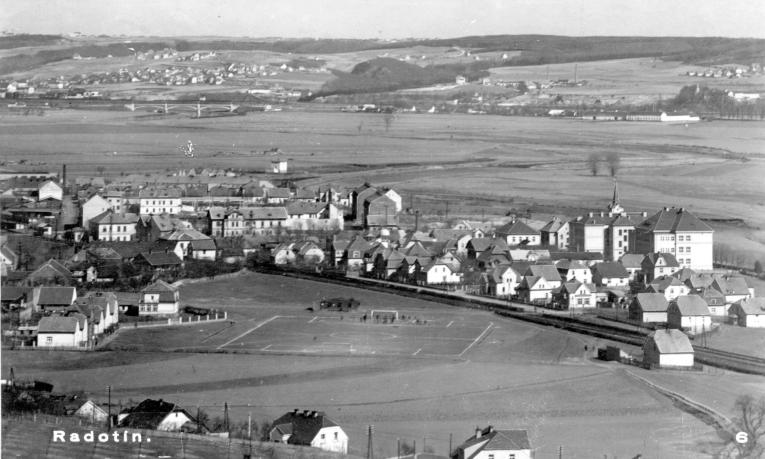
The cinder pitch as it looked in the 1930s. Today, a modern sports hall and a softball arena stand on this site.
Photo: Archive of the Radotín Chronicle Commission
After Radotín’s home‑grown players returned from compulsory military service, the club—now playing under the name Spartak Radotín—began an extraordinary rise through Czech football. In 1955, the team won the I.B division and advanced to the I.A division. One year later, they claimed the title of Regional Champions of the Tyrš Region and secured promotion to the division league. In 1958, Spartak Radotín reached the Second League.
Average attendance was remarkable: around 3,000 spectators at league matches and 600–800 at regular Wednesday friendlies.
After relegation from the Second League, a generational change followed, and the team continued to play in the division until the 1961/1962 season. In the anniversary year 1962, the team once again earned promotion to the Second League, where they achieved third place in the table in the following two seasons. After five years at this level, the team was relegated to the regional championship in 1966/1967, then to the division in 1973, where they remained until the 1974/1975 season. In recent years, the A‑team has been a traditional and respected contender in the Prague Championship.

In 1945, Radotín players played a match against SK Slavia, featuring the legendary Josef Bican (far right).
Photo: Archive of the Radotín Chronicle Commission
Women’s football was played in Radotín until 1976, with a women’s team active from autumn 1975. A major milestone came in 2006, when SC Radotín transformed the old cinder training pitch into a modern third‑generation artificial‑turf field. In 2009, the natural‑grass pitch was renovated and equipped with automatic irrigation. In 2020, a new building with full facilities for athletes—and a new bowling alley—was added to the site.
Independent Tennis Club – LTC
The first tennis courts were built in 1926 on a meadow by the Berounka River, opposite Matějovského Street, on the site where a car repair shop stands today. However, the efforts of a few enthusiasts were repeatedly thwarted by the river itself, which regularly flooded the courts each spring during snowmelt and drifting ice.
In 1930, an agreement was reached with the Zbraslav estate owners, which provided a plot of land free of charge at the junction of Výpadová Street and Šárovo kolo. The tennis courts remain there to this day. Unfortunately, no official document confirming the transfer of the land has survived, and so in 1993—after 63 years—the Catholic Church asserted its ownership rights, and the club has since paid annual rent for the site.
From 1930 onward, club members—mostly through their own labour, financial contributions and sponsorship—built six courts, a practice wall, a clubhouse, caretaker facilities, sanitary amenities, a well and greenery that shaped the club’s sporting and recreational character. The year 1939 brought the need to formalise the club’s activities. Its statutes were drafted and approved, and from that moment the club was officially recognised under the name LTK Radotín. Later, a volleyball court was added, and this sport also brought notable success to the club.
Several well‑known players appeared on the Radotín tennis courts, including Jaroslav Drobný, Czechoslovak national team member and later Wimbledon champion, who played here in 1942. The overall level of tennis gradually improved. Since 1940, the club has continuously trained its own youth players, many of whom have remained active members.
In 1949, the club was incorporated into TJ Sokol Radotín, and with the later reorganisation of sports under individual enterprises, it adopted the name TJ Spartak Radotín – ZRL. This change also brought significant financial support. The original wooden clubhouse was replaced with a brick building offering full facilities.
The club’s greatest sporting achievements were earned by MUDr. Eva Marková, who later transferred to the top‑tier club Slavia Praha, where she ranked among the country’s elite for several seasons. In 1950, she won the national junior championship (Pardubická juniorka) in the under‑16 singles category and, together with Jiří Dostrašil, also claimed the mixed‑doubles title. She repeated the mixed‑doubles victory in 1952 and, one year later, won the national women’s doubles championship. She eventually returned to the Radotín club.
After the devastating flood of 2002, a court with a new artificial surface was built. For the past twenty years, an inflatable winter hall has been erected each season over Court No. 1.