1a. Education in Radotín
The first mention of Radotín’s “schoolmasters” dates back to 1715. The Třebotov parish records list Martin Tichý (1715–1720), Jan Hráza (1720–1748), and Jiří Jůra (1748–1751) as the earliest known teachers. At that time, the teacher both lived and taught in the so‑called zádušní chalupa (parish cottage), built in 1684 near the church, on the grounds of today’s town hall. This is where local children were taught from 1715 until 1820.
After Empress Maria Theresa introduced compulsory schooling in 1774 for children aged six to twelve, the number of pupils increased and the original room was no longer sufficient. In 1820, the cottage was enlarged by adding two new rooms and was rather grandly referred to as a “school”.
However, the number of pupils continued to grow. This was largely due to the extension of compulsory schooling from six to eight years, as well as the rising population of Radotín and the neighbouring villages assigned to the school. Time took a heavy toll on the old parish cottage, and by 1858 it had deteriorated into what was described as the most miserable hut. Only then did discussions begin about constructing a new school. Yet due to the municipality’s indifference, lack of foresight, and the district authority in Zbraslav showing little interest, teaching in this “medieval hovel” continued until 1871.
Construction of the new building (today’s town hall) began in the spring of 1872. Teaching in the new school started on 15 September of the following year. At first, the school had only one classroom. It became a two‑class school a year later, when head teacher Václav Schmidt took up his post in 1874. At that time, there were 141 pupils under the age of 14 in the two classes — 104 from Radotín and 37 from Horní Černošice. On 1 January 1888, the school was expanded to three classes. By 1890, it was attended by 219 pupils.
As pupil numbers continued to rise, even this building soon proved insufficient. Therefore an entirely new school was constructed and formally opened on 15 September 1901, directly opposite the church. It contained five classrooms, a gymnasium with a changing room, a staff room and a teachers room There was also a three‑room apartment for the head teacher, and a caretaker’s flat with one room and a kitchen. Lessons were held throughout the day, with Wednesday and Saturday afternoons free. In the first school year, 1901/1902, a total of 284 children were taught here. On 10 May 1911, Josef Krček was appointed the permanent head teacher. By then, the school already had 361 pupils.
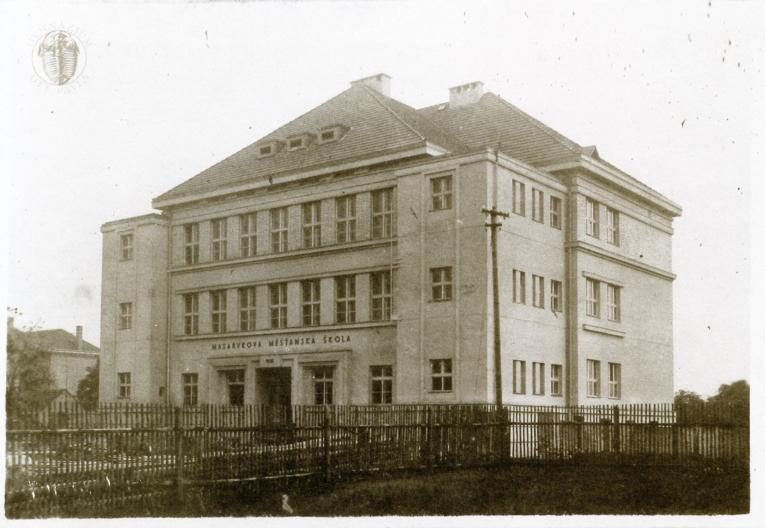
The building—today’s grammar school—has remained virtually unchanged in appearance from the outside (photograph from 1928).
Just before the outbreak of the First World War, a fifth progressive class was established. This meant that pupils attended the first to third grades for one year each, the fourth grade lasted two years, and the fifth grade three years. Once a pupil reached the age of fourteen, they left school. By this time, the school was attended by 400 children.
After the First World War, the school had 250 pupils, but their number continued to rise. The lack of space in the single‑storey building again became critical, and so a second floor was added during the summer holidays of 1931. By the 1932/33 school year, the school already had 433 pupils and 11 classes.
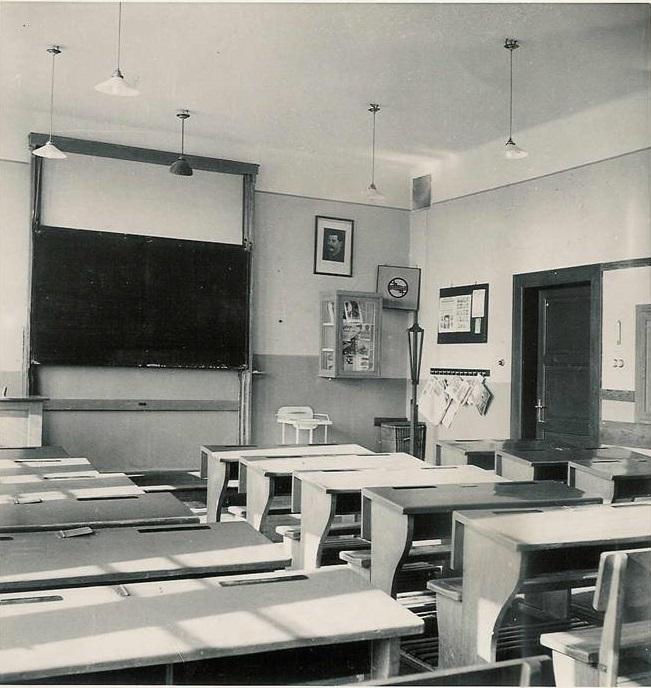
Interior of a classroom in 1928
Photo: Archive of the Radotín Chronicle Commission
Interesting Facts
- In 1937, children from low‑income families could borrow textbooks from the school
- Compulsory German lessons were introduced after 1939, applying to pupils from the third grade onwards.
- A kindergarten also operated alongside the primary school.
- During the war years, two boards with bilingual text were hung at the entrances to the school buildings. School stamps were also translated into two languages.
- By order of the District School Board Prague–Rural, Jewish children were forbidden to enrol.
From 1941, new regulations on the number of pupils per class came into force. This led to the introduction of so‑called school shifts : one half‑day for the primary school, the other half‑day for the měšťanka (referred to as the “main school”).
In October 1944, the school building was taken over by the army, and pupils were moved to the main facility. Lessons were frequently interrupted by air‑raid alarms, and children repeatedly ran home. Classes were merged so that nine teachers taught nine combined classes. At that time, the school had 473 pupils.
After the war, on 1 September 1946, Rudolf Pešina—who had been retired during the war—became headmaster of the boys’ primary school, while Jaroslav Fiala was in charge of the girls’ school.
In 1948, the name “primary school” was changed to “national school”. It had 304 pupils, and its headmaster remained Rudolf Pešina.
From the 1948/1949 school year, a new law on the basic structure of unified education came into effect, introducing a single educational system for all young people. Under this law, children were to attend: – kindergarten from ages 3 to 6, – schools of the 1st and 2nd level from ages 6 to 15, – and schools of the 3rd level for older youth.
In 1953, a new school law was issued that introduced eight years of compulsory schooling. The basic type of school became the eight‑year primary school, and alongside it an eleven‑year secondary school was created, ending with the school‑leaving exam. This change also affected Radotín. The secondary and national schools were again merged under one administration, and one eleven‑year school was established. Miroslav Lebeda was appointed headmaster, and the history of the Radotín grammar school began.
The teaching staff stabilised at 25 teachers, who taught 840 pupils. Because of this, alternating teaching shifts had to be introduced again. On 1 January 1958, a modern school canteen located between the school buildings was opened. In the 1962/1963 school year, 1,089 pupils were taught here.
On 1 February 1965, the administration of the two schools was once again permanently separated. Jaroslav Sláma became the headmaster of the Primary School which had 858 pupils. Both schools used the same buildings, which were owned by the local municipal authority The separation did not bring any improvement: the lower grades still had to be taught in shifts, and pupils of the upper grades and students of the secondary school had to move from one building to another. This continued until the opening of the new primary school building in 1969, when the construction of the school complex was completed. The new building was intended for the upper grades of the primary school. A modern canteen was built in a separate pavilion, with an after‑school club above it.
In 1975, the first talented pupils were allowed to enter the grammar school after completing the eighth grade of the primary school. This system lasted until 1981.
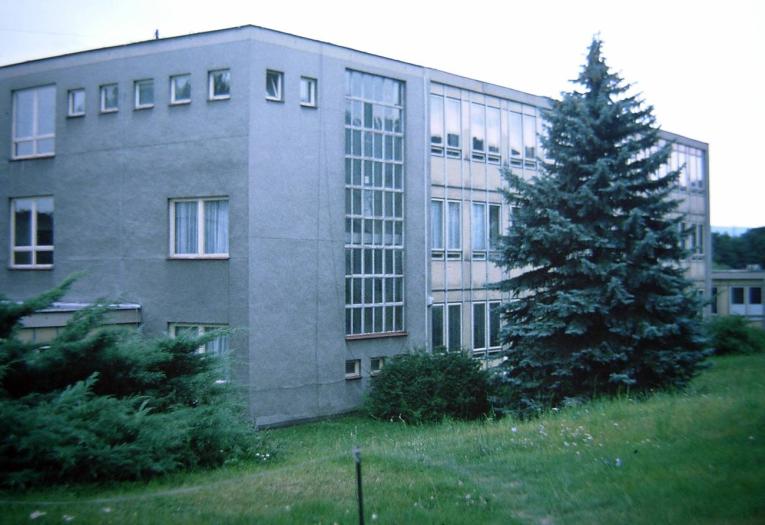
The upper level of the primary school in Loučanská Street forty years ago
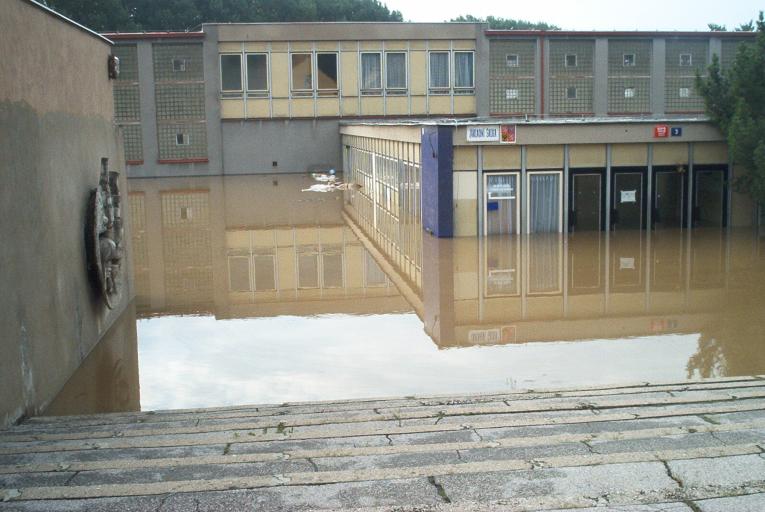
During the floods in August 2002, the primary school was one of the most damaged buildings in all of Radotín.
After the 2002 floods, the new school in Loučanská Street underwent a complete reconstruction, followed by several stages of expansion, new buildings, and extensions of the pavilions. A multi‑purpose sports field with an artificial surface was built, and in 2009 the children received a traffic playground. A year later, a running track with a jumping area was added. In the same year, a flood‑protection wall around the school complex was completed. In 2012, new changing rooms and one after‑school club classroom were added. The first level of the primary school on Sts. Peter and Paul Square was also expanded in 2019 with an extension and an added floor to the historic building.
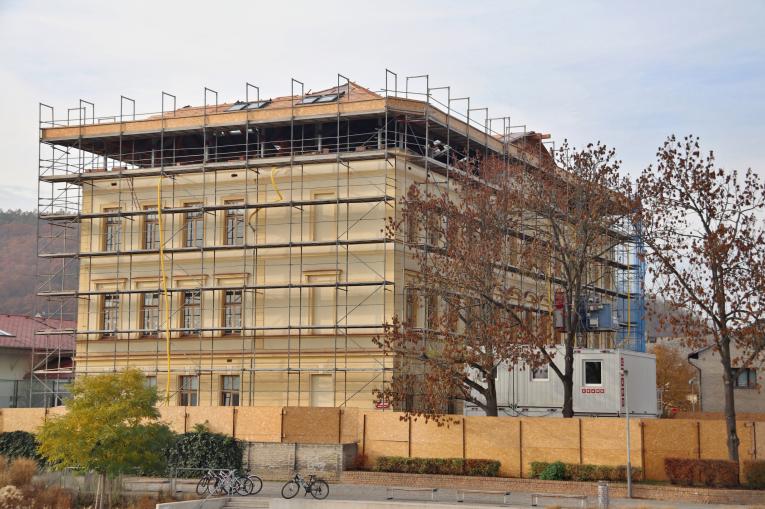
The top floor of the historic school building from 1901 was added in 2018–2019

It now offers everything modern teaching requires, as well as exceptional views of Radotín.
The fully renovated and extended school complex was enlarged in 2018 with a modern multi‑purpose hall (completed in 2022).

Interior of the school hall (2018)